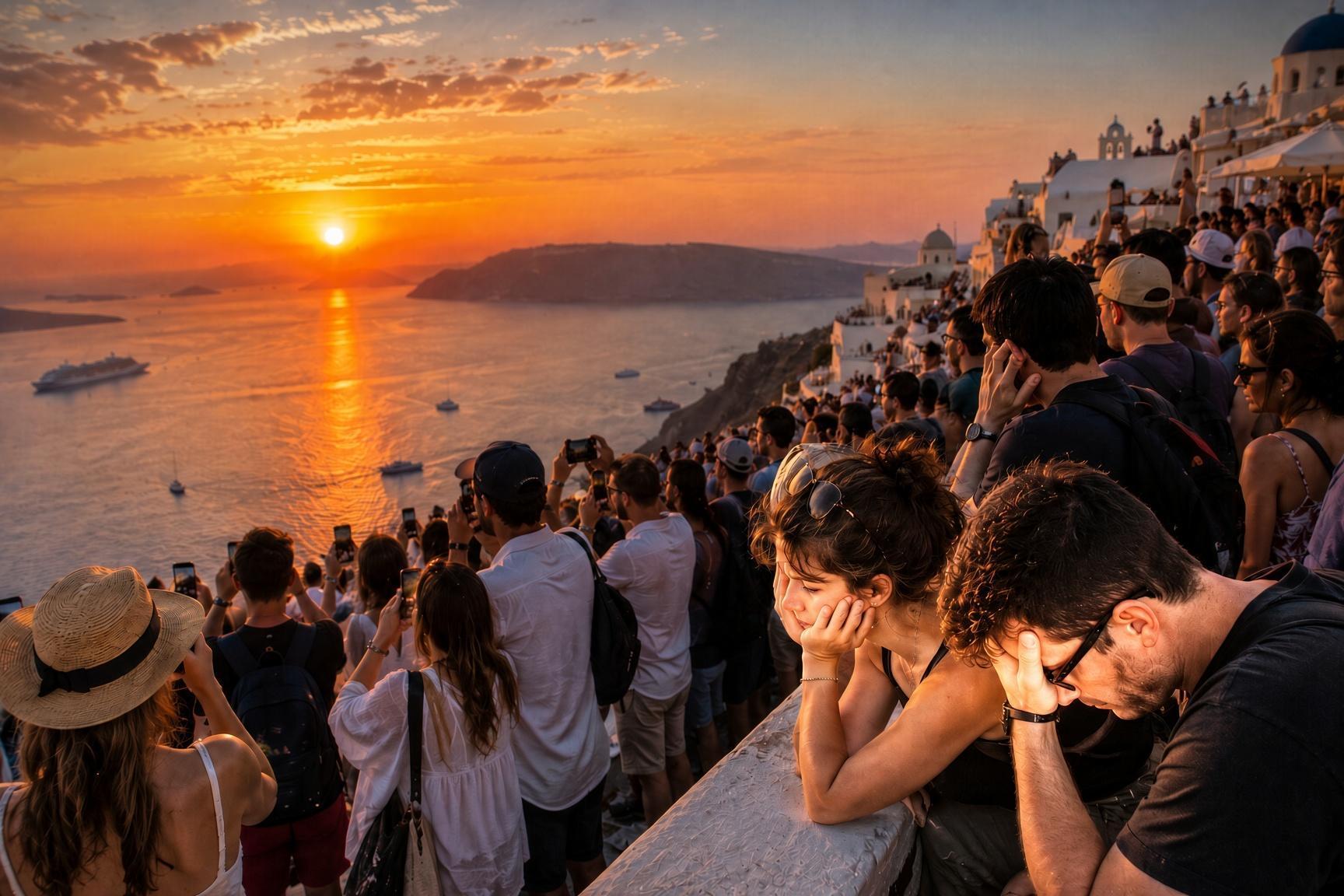
The second most photographed island in the world has disappeared from the lists of the top 25 luxury destinations.
According to an industry estimate, Santorini dropped out of the top 25 after three years of headlines about queues, overcrowded alleys and packed viewpoints.
And those headlines did not simply disappear.
They became data.
Data that AI systems now read, process and use when deciding what destinations to recommend.
Today, instead of Santorini, AI is increasingly suggesting places such as Naxos, Chania and Milos.
And that changes an old rule of tourism.
Until recently, a destination could take in more visitors than it could comfortably handle and still come out ahead. Some tourists would leave disappointed and never return, but there would always be others waiting to take their place.
The destination’s name was simply too powerful.
Poor organisation, overcrowding and a few angry tourists were unlikely to do much lasting damage. By the following summer, everyone had moved on.
The complaints left the island with the people making them.
Not anymore.
AI doesn’t Forget in September
In the age of artificial intelligence, the complaint counter does not reset to zero at the end of every tourist season.
Every bad experience becomes part of a destination’s digital record.
It appears in reviews, social media posts, blogs, travel forums and news reports. And AI systems read all of it.
So this year’s frustrated visitor can influence next year’s tourist.
A complaint posted today may return months later in the form of an AI recommendation:
“Don’t go to that island this year. Reviews are poor. Try this one instead. Visitors seem much happier there.”
That is a very different mechanism from traditional word of mouth.
And it operates at a scale no tourist board can easily control.
But Myconos is Crowded Too!
True.
So why should Santorini have a problem while Mykonos continues to thrive?
Because the crowds play a completely different role in the two destinations.
In Mykonos, crowds do not necessarily diminish the visitor experience.
To some extent, the crowds are the experience.
The packed beach clubs, the nightlife, the people, the energy and even the excess are part of what many visitors are paying for.
In Mykonos, the crowd is part of the product.
Santorini is different
Too many people can destroy the very thing visitors came to experience.
The Caldera view. The landscape. The atmosphere. The sense of space. The romantic image of sitting somewhere above the Aegean and watching the sun disappear into the horizon.
Romance and sunset views do not work quite as well when several thousand people are trying to take exactly the same photograph.
Santorini therefore has a different tourism profile and a fundamentally different relationship between visitor numbers and visitor satisfaction.
Beyond a certain point, more tourists do not simply mean more business.
They mean a worse product.
The Travel Agent Now Has AI
Until very recently, travel agents relied heavily on reputation, established international rankings and their own professional knowledge when recommending destinations.
Today, for around €20 a month, they can have an AI system sitting beside them.
Research that once took days or weeks can now be done in minutes.
And the crucial difference is that AI can look at what travellers are saying this year.
Not last year.
This year.
A travel agent gains nothing from sending a client to Santorini only to have them return complaining about unbearable crowds, inflated prices and an exhausting experience.
The agent can now ask AI to find alternative destinations with better recent reviews and a better match for that particular traveller.
The objective is obvious.
Send the customer somewhere they will enjoy.
Make sure they come back to the same travel agent next year.
And when that happy customer posts a positive review, the destination itself benefits as well.
A feedback loop begins.
Unfortunately, negative feedback loops work exactly the same way.
Carrying Capacity has become Real-Time
Urban planners, tourism planners and environmental specialists have been talking about carrying capacity for decades.
In simple terms, it means asking how many visitors a place can accommodate before the number of visitors starts damaging the place or degrading the experience they came for.
Traditionally, we measured this through specialised studies, statistics, infrastructure capacity and planning analysis.
That system still matters.
But something else is now happening alongside it.
Visitors themselves are carrying out a continuous, informal assessment of carrying capacity.
Twenty-four hours a day.
Three hundred and sixty-five days a year.
And publishing the results.
“It was wonderful. Highly recommended.”
Or:
“Terribly overcrowded. We hated it.”
Millions of these tiny assessments now form part of the digital identity of a destination.
And artificial intelligence can read them collectively.
Which means that carrying capacity is no longer merely a planning concept hidden inside technical reports.
It is becoming part of the market.
And the market can react very quickly.
Perhaps much more quickly than the destination itself.
For the Prince
September 2026
PS. I tested this myself today with the following question:
“Based on the experience of international visitors to Greece during the first half of 2026 and throughout 2025, would you recommend spending five days in Santorini, or would you suggest somewhere better?”
The answer was brutal:
“International demand for Oia has reached saturation point, while the visitor experience is consistently affected by overcrowding, high prices and regulatory pressures. For a five-day stay, other destinations offer a clearly better balance of experience, cost and comfort. Consider Naxos, Chania or Milos instead.”